- PRATIQUE FLAG
- See ‘quarantine flag’.
![[quarantine flag]](../images/v/vxt-d1117.gif)
Pratique/Quarantine Flag (fotw)
- PRAYER FLAG
- A small, sometimes triangular flag, often used in groups and decorated with inscriptions, intended
to express a prayer as it flies – characteristic of Hinduism, Buddhists in the Himalayan
region and of a related Chinese sect (see also ‘Buddhist flag’,
‘dhvarja’,
‘pavon’,
‘thangka’ and
‘religious flag’).
![[Hindu prayer flag]](../images/v/vxt-d4609.gif)
![[Hindu prayer flag]](../images/v/vxt-d268a.gif)
![[Hindu prayer flag]](../images/v/vxt-d268b.gif)
Hindu Prayer Flags (fotw)
- PRECEDENCE
- The system often regulated by law, of placing flags, emblems or coats of arms
for a display or ceremony in order of importance – for more details see
‘Appendix II’,
‘rules of etiquette’ and
‘position of honour’ (also
‘flag code’ and
‘flag law’).
- PRE-HERALDIC
- A term that relates to European flags which do not contain any elements derived
from heraldry and/or which pre-date the introduction of heraldic symbolism. (see also
‘anti-heraldry’,
‘dragon flag 1)’,
‘flammula 2)’,
‘gonfanon’,
‘heraldry’) and
‘pallia’).
![[pre-heraldic flag]](../images/v/vxt-d4147.gif)
![[pre-heraldic flag]](../images/v/vxt-d2662.gif)
![[pre-heraldic flag]](../images/v/vxt-d2643.gif)
Oriflamme/War Flag of Charlemagne c800 (fotw);
Cavalry Flag c1150, Spain (fotw);
Royal Standard of Ramiro I c845, Asturias (fotw)
- PREPARATIVE (or PREPARATIVE FLAG/PENNANT)
- In British RN usage and in some others, the signal flag hoisted before a message
is sent and hauled down after that message has been completed (see also ‘hoist 2)’
and ‘signal
flag’) – but see note below (also ‘code pennant’ with its following note,
‘distinction pennant 1)’
and ‘Marryat&r#39;s code’).
![[preparative flag]](../images/v/vxt-d3541.gif)
![[preparative flag]](../images/v/vxt-d924.gif)
![[preparative flag]](../images/v/vxt-d926.gif)
Preparatives: Howe’s and Popham’s Codes 1790 - 1810, and in the Naval Code of 1889, UK; Marryat’s Commercial Service Code of 1817, UK;; Current Naval Code, UK/NATO
(fotw)
Please note that this flag was originally introduced in Howe's code of 1790 to indicate that the following message was not to be obeyed immediately, but only when the preparatory was again raised and lowered, and
that the term has also been used to describe a “telegraph flag” in Popham's code of 1799
– see ‘telegraph flag’.
- PREPARATORY FLAG
- Flag P (Papa) in the International Code of Signal Flags hoisted to indicate
the imminent start of a yacht or dinghy race (see also ‘blue peter’,
‘international code of signal flags’,
‘prize flag’,
‘race signals’ and
‘racing flag’.)
![[Blue Peter - ICS Papa]](../images/v/vxt-d044.gif)
Signal Flag P (Papa) (fotw)
- PRESENTATION
- In UK usage and in some others, the term for a ceremony at which a regiment (or other
unit) is presented with its colour or colours (see also
‘colour 2)’ and
‘colours 2)’).
![[Presentation of colour]](../images/v/vxt-d1334.jpg)
Presentation of a King's Colour to the Royal Navy by HM King George VI in 1939
- PRESIDENTIAL ARMS (or PRESIDENTIAL COAT OF ARMS)
- 1) See ‘state arms 1)’ under ‘arms’
(also ‘presidential standard’).
- 2) Those arms, sometimes differing slightly from any state versions, which symbolize the office of president.
![[Serbian Presidential arms]](../images/v/vxt-d3356.gif)
![[Lithuanian Presidential flag]](../images/v/vxt-d4846.gif)
![[Trinidad & Tobago presidential arms]](../images/v/vxt-d2261a.gif)
Presidential/State Arms, Serbia (fotw);
Presidential Flag/Arms, Lithuania (fotw);
Presidential/State Arms, Trinidad and Tobago (fotw);
- PRESIDENTIAL (or PRESIDENT’S) COLOUR (or COLOR)
- 1) See ‘colour 2)’ and
‘colours 2)’.
- 2) In largely US usage, a term for the distinguishing flag of a president
when displayed indoors, or on parade when it is invariably fringed (see
‘presidential standard’).
![[Presidential colour]](../images/v/vxt-d2433.gif)
![[Presidential colour]](../images/v/vxt-d3358.gif)
President’s Colour India (fotw);
Presidential Standard in Parade Format, USA (Graham Bartram)
- PRESIDENTIAL DECREE
- In some republican usage the legal means by which a head of state authorizes display of a flag or the
amendment of an established design, and the equivalent to a US Executive Order or Royal Order in Council –
see ‘executive order’ ‘royal decree’ and
‘royal order in council 2)’
(also ‘flag law’).
![[Presidential decree]](../images/v/vxt-d4316.gif)
![[Naval Jack of Kazakhstan]](../images/v/vxt-d2955.gif)
![[Presidential Flag of Greece]](../images/v/vxt-d2956.gif)
Flag of the Minister of Education, Belarus,
Naval Jack of Kazakhstan and
Presidential Flag of Greece all authorized/introduced by Presidential Decree
- PRESIDENTIAL SASH
- See ‘sash 1)’.
![[Presidential sasg]](../images/v/vxt-d469.gif)
Presidential Sash of Colombia (fotw)
- PRESIDENTIAL STANDARD (or FLAG)
- That flag which symbolizes the office of president in a republican system
of government, often (but no means exclusively) a defaced or decorated version of the national flag (see
also ‘deface 1)’,
‘distinguishing jack 2)’,
‘national flag’,
‘presidential arms’ and
‘royal standard’).
![[presidential standards]](../images/v/vxt-d253a.gif)
![[presidential standards]](../images/v/vxt-d253c.gif)
![[presidential standards]](../images/v/vxt-d1774.gif)
Presidential Standard
of Chile (fotw); Presidential Standard of
Croatia (fotw); Presidential Flag of
Iceland (fotw)
- PRETENTIOUS FLAG
- See ‘flag of pretence 1)’.
![[flag of pretence]](../images/v/vxt-d1483.gif)
Naval Ensign of Bolivia 1966 - 2013 (fotw)
- PRIAPIC IN ITS VIRILITY
- A phrase sometimes used in heraldic blazoning when the male member of an animal is shown erect and in
a different tincture to its body – villené, vilene or viriled (see also
‘blazon’ and
‘tincture’).

Flag of Appenzell, Switzerland (fotw)
- PRINCELY CORONET (or HAT)
- See ‘coronet 2)’.


Princely Coronet/Hat (Wikipedia); National Flag of Liechtenstein bearing a
Coronet/Hat (fotw)
- PRINCEFLAG (PRINCE FLAG, PRINCE’S FLAG, PRINSENVLAG or PRINZENVLAG)
- The alternative names originally applied to the orange-white-blue horizontal tricolour that was the first
pattern of Dutch national flag, the driekleur, and in use from c1575 – c1654/1660 – the prinsenvlag
or prinzenvlag (see also
‘double-prince’,
‘Dutch colours 1)’,
‘driekleur’,
‘triple-prince’ and
‘tricolour 2)’).

National Flag of the Netherlands c1575 – c1654/1660 (fotw)
Please note, evidence indicates that until the late 18th
Century the terms prinsenflag or prinzenvlag were sometimes also applied to the
red-white-blue tricolour.
- PRIVATE SHIP
- In British RN and some other naval usage, a vessel in commission that does
not fly the flag of a flag officer or broad pennant of a commodore (see also
‘broad pennant’,
‘flag of command’,
‘flag officer’,
‘flagship’ and
‘masthead pennant 1)’).
- PRIVATE SIGNAL
- 1) See ‘call sign’ and
‘call sign hoist’.
- 2) See ‘house flag 3)’.
- 3) A naval term, now obsolete, for a confidential signal used by ships of
the same navy to verify each other's identity (see also
‘make her number’ and
‘pendant number’).
- PRIVATEER(S)
- The term for a merchant vessel, or for the crew of such a vessel, holding a licence (or letter of marque)
from its government which entitled that vessel, or its crew, to attack the property of those countries
with whom they were at war - a practice now obsolete - corsair(s) - see
‘privateer ensign’ and ‘privateer jack’.

A French Privateer attacking a British East Indiaman 1800 (Wikipedia)
Please note that possession of a letter of marque (and/or reprisal) also entitled
the holder and/or his crew to be treated as prisoners of war rather than face execution
if captured - which was (and in some cases still is) the legal punishment for piracy on
the high seas (see also ‘jolly roger 1))’).
- PRIVATEER ENSIGN (or PRIVATEERING ENSIGN)
- In Spanish usage and some others, now obsolete, a special ensign prescribed for vessels engaged
in privateering – a corsair ensign – see ‘privateer(s)’ and
‘privateer jack’ (also
‘ensign 1)’ and
‘jolly roger 1)’).
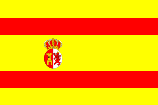

Privateer Ensign, Spain 1820 (fotw); Privateer Ensign Proposal 1819, Austria-Hungary (Fame)
- PRIVATEER JACK (or PRIVATEERING JACK)
- In English then UK usage, now obsolete, a special jack prescribed for vessels engaged in privateering and flown
from 1694 until 1856 – the distinction jack
or budgee jack see ‘privateer(s)’
and ‘privateer ensign’ (also
‘budgee flag’,
‘budgee pendant’,
‘jack’ and
‘union jack 2)’).
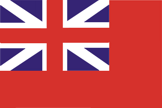

Privateer Jack 1694-1801, England/UK (fotw);
Privateer Jack 1801 – 1856, UK (fotw and CS)
- PRIZE FLAG
- A special flag flown by a yacht that has won a race (see also ‘preparatory
flag’, ‘race signals’ and ‘racing
flag 1)’).
