- REMEMBRANCE FLAG
- See ‘memorial flag 2)’.
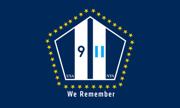
9/11 Remembrance/Memorial Flag, US
(fotw)
- RENAISSANCE SHIELD
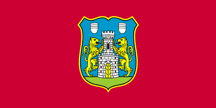
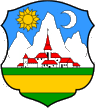
- The term often used to describe a variously detailed but elaborate late-medieval, post-medieval,
Baroque or heart-shaped shield – see ‘shield’ (also ‘horse-head shield’).
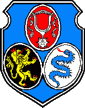
Arms of Dachau, Germany (fotw);
Flag of Ilok, Croatia (fotw);
Ceremonial Arms of Ravna Gora, Croatia (fotw)
Please note that several of the terms giving shields a national identity, as well as those describing a specific type, are still in the process of standardization, and that no consistent approach has thus far been identified, however, use of this specific term is both widespread and consistent, so it may be employed with some confidence.
- REPEATER (or REPEATER PENNANT)
- See ‘substitute’.


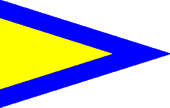
I-L-L (India-Lima-Lima) in The ICS using the
First Repeater/Substitute Pennant (fotw)
- REPEATING FRIGATES
- The 18th/19th Century term, now obsolete, for those frigates that were stationed outside or behind the
main line in a fleet of sailing or steam-assisted warships in order to relay flag signals to ships out of view of the
flagship (see also ‘flagship’, ‘man-o-war’
and ‘signal flag’).
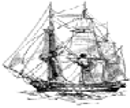
British Frigate c1805 (Wikipedia)
Please note that in the context of the above definition a
frigate was a naval vessel which carried her main armament on a single, part-enclosed deck.
- REPLICA FLAG (or REPRODUCTION)
- The terms which may be used to describe that flag which is a visual or actual reproduction of an
earlier design – a reproduction (see also
‘fictitious flag’ and
‘flag of pretence 1)’).
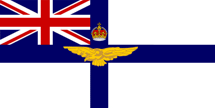

A rejected design of 1919 (for a Flag of the RAF) flown as a Replica in 2010
(fotw); Reproduction of the Standard of
Constantine the Great c323 (fotw)
- RESERVE ENSIGN
- See under ‘ensign’.
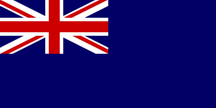

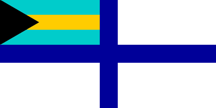
Reserve Ensign of the UK (fotw); Reserve Ensign of
Sri Lanka (fotw); Reserve Ensign of The Bahamas (fotw)
- RESPECTANT
- The heraldic term used when two animals are depicted facing towards each other –
but see combatant and
affrontant.
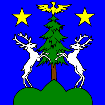
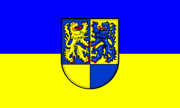
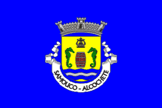
Flag of Nax, Switzerland (fotw);
Flag of Northeim County (Germany);
Flag of Samouco, Portugal (fotw)
- RETREAT CEREMONY
- In military usage, a formal ceremony requiring a full guard and band for lowering
the national flag at the end of the day on special occasions (see also
‘reveille’ and
‘sunset’).
Please note that this ceremony has its roots in
late Medieval and early Renaissance period with the formal ceremonies associated
with closing the gates of fortresses and castles for the night.
- REVEILLE
- In UK, US and some other military usage, the ceremony of hoisting the national
flag at the start of a day and taken from the name of the bugle call sounded to
awaken the troops (see also 'colours 5)' and
'retreat ceremony').
- REVERSE
- The less important side of a flag which in the Western tradition is always depicted with its hoist to the observer’s right and is generally, but not invariably, a
mirror image of the obverse – see ‘obverse’ (also
‘ceremonial flag 1)’,
‘colour 2)’,
‘right hoisted’,
and ‘unique flag’).
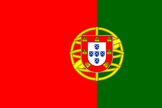
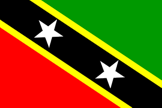
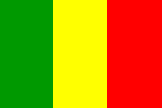
Reverses: National Flags of Portugal,
St Kitts and Nevis and Guinea (fotw)
Please note that a distinctive reverse design or charge will usually only be found on unique flags, ceremonial flags, regimental colours and similar, there are however, occasional exceptions - see 'double-sided
1)' and 'two-sided 1))'.
- REVERSE BEND
- See ‘bend sinister’

Flag of Monfarracinos, Spain (fotw)
- REVERSED
- 1) On flags, the term is used to refer to a charge or charges that run in the opposite
direction to that in which they are normally placed (see also
‘reversed chevron’,
‘reversed pall’, ‘reversed pile’
and ‘reversed triangle’).
- 2) In heraldry, as above but the term is also used when arms or a charge are reversed or turned downward
– debased, everted, inverted, subverted, subvertant or transposed.


Flag of Birżebbuġa, Malta (fotw); Example
- REVERSED CHEVRON
- See ‘chevron 1)’ and
‘chevron 2)’.
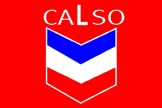
Flag of the California Transport Corp. c1953 (fotw)
- REVERSED PALL
- See 'pall 1)'.
![[reversed pall]](../images/v/vxt-d492.gif)
Flag of Krasnoarmeyskiy, Russia (fotw)
- REVERSED PILE
- See ‘pile 1)’.
![[reveresed pile]](../images/v/vxt-d491.gif)
Flag of Paszowice, Poland (fotw)
- REVERSED TRIANGLE
- See ‘triangle 1)’.

Flag of Łomża rural district,
Poland (fotw)
- RHOMBUS
- See ‘lozenge 1)’.
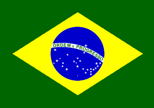
National Flag of Brazil (fotw)
- RIBBON
- 1) See ‘scroll’ (also ‘ribbon scroll 2)’).
2) See ‘cravat 2)’ and ‘draping’.
3) A term that is also (and inaccurately) used to describe a wavy stripe – see ‘wavy’.
- RIBBON SCROLL
- 1) Generically, see ‘scroll’.
- 2) Specifically, the term used for a narrow ribbon in the form of a scroll
but of greater length than is usual); it is normally (but not exclusively)
placed below and/or around the shield in a set of armorial bearings or an
emblem, and is generally inscribed with a motto – a ribbon.
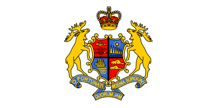

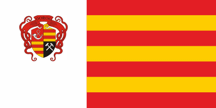
Flag of Saint John, Canada, (fotw);
Arms and Flag of Dorog, Hungary (Wikipedia
& fotw)
Please note with regard to 2) that further examples (amongst several) are to be found on the flags of the US States of
Iowa and Massachusetts (see also ‘scroll’).
- RIGHT DIAGONAL (or RIGHT DIAGONAL BAR)
- See ‘bend’ and ‘descending diagonal 1)’.
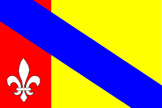
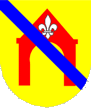
Flag and Arms of Waaxens, The Netherlands (fotw)
- RIGHT-ANGLE TRIANGLE
- See ‘triangular panel 2)’).
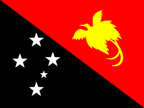
National Flag of Papua New Guinea (fotw)
- RIGHT-HOISTED
- A term that may be used (in place of its heraldic equivalent) when the obverse of a
flag is depicted (or is manufactured) with its hoist to the observer’s right in accordance
with Arabic tradition – but see
‘sinister hoist’ and the note below (also
‘hoist 1)’, ‘obverse’
and ‘reverse’).

National Flag of Qatar (fotw)
Please note that the Editors recommend use of the heraldic term as being more
accurate and will avoid any potential confusion.
- RIKSBANNER (or RIJKSVAANDEL)
- See ‘coronation flags’.
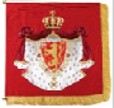
Riksbanner/coronation Flag, Norway 1906 (Official Website)
- RING
- 1) On flags a charge in the form of a narrow circular band typically (but
by no means exclusively) used to separate a sun’s central disc from its rays,
as on the flag of Kyrgyzstan (as illustrated below) – a torus or disc/disk voided (see
also ‘disc’ and
‘cartouche’).
- 2) In heraldry see ‘annulet’.
- 3) A piece of wood or metal for attaching a windsock to its pole and for keeping
it open (see also ‘windsock’).
- 4) See ‘battalion ring’ and
‘battle honour’.
- 5) One of a number of circular metal bands used as an increasingly (but
not entirely) obsolete method of attaching a military colour, parade flag or
gonfalon to its staff - see ‘colour 2)’,
‘parade flag 2)’ with its following
notes and ‘gonfalon 2)’
(also ‘loops’ and
‘ties’).
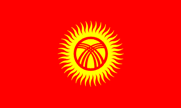
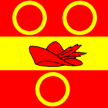
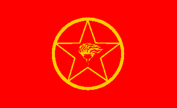
National Flag of Kyrgyzstan (fotw);
Flag of Bercher, Switzerland (fotw); Flag of the Kurdish Workers Party,
Turkey (fotw)
- RISING
- 1) In heraldry the term used when a bird is represented as in the act of taking flight
(see also ‘displayed’,
‘vol’ and
‘volant’.
2) In vexillology the term often employed to describe a sun complete with its
(usually – but not invariably – expanding) rays – a rising sun (see also
‘rays’ and
‘sunburst’)
![[rising example]](../images/v/vxt-d1249b.gif)
![[rising example]](../images/v/vxt-d1249a.gif)
![[rising example]](../images/v/vxt-d4673.gif)
Flag and Arms of Złocieniec, Poland (fotw);
Flag of the Airforce, The Soviet Union (fotw)
- RISING DIAGONAL
- In heraldry see ‘ascending diagonal’.
![[rising diagonal example]](../images/v/vxt-d653.gif)
Flag of Franekeradeel, Netherlands (fotw)
- RISING FROM
- See ‘issuant’ (also ‘rising 1)’.
![[rising form example]](../images/v/vxt-d4674.gif)
Flag of Schinznach, Switzerland (fotw)
- RISING SUN
- See ‘rising 2)’.
![[rising sun example]](../images/v/vxt-d4675.gif)
Flag of Nova Aurora, Brazil (fotw)
- RIVERWHEEL (or RIVERMILL WHEEL)
- See ‘waterwheel’.
![[Fafe, Portugal]](../images/v/vxt-d2647a.gif)
![[Fafe, Portugal]](../images/v/vxt-d2647.gif)
Flag of Fafe, Portugal (fotw)
